Digital Assets, Stablecoins, and Artificial Intelligence in Banking:
Emerging U.S. Regulatory Expectations and Compliance Challenges for Arab Banks

Introduction: Banking is changing, and so are the rules
Digital assets, stablecoins, and artificial intelligence (AI) are changing the way financial services are delivered. Payments can be made more quickly, financial transactions can be processed around the clock, and AI systems can help banks detect suspicious activity, assess credit risk, and serve customers more efficiently. For banks, these developments offer opportunities to improve services, reduce costs, and strengthen their position in international markets. However, innovation also brings new risks. Digital assets can create challenges in identifying customers and tracing transactions. Stablecoins can introduce new questions about redemption, reserves, and the movement of funds across borders. AI systems may improve decision-making, but they can also produce inaccurate results, expose sensitive information, or make decisions that are difficult to explain.
The United States is developing its regulatory approach to these developments, with particular attention to financial stability, consumer protection, cybersecurity, and the prevention of money laundering and sanctions evasion. These changes matter to all banks, even when they do not operate directly in the U.S. market. Their international partners, dollar transactions, technology providers, and customers may connect them to the evolving U.S. regulatory environment. The challenge is to embrace innovation without weakening the controls that protect banks, customers, and international financial relationships.
Digital assets: New opportunities and new responsibilities
Digital assets are no longer confined to cryptocurrency trading. Banks and financial institutions are exploring digital custody, tokenized deposits, blockchain-based settlement, and the use of distributed ledger technology in trade finance and other financial services. These developments could help reduce settlement times, improve the traceability of transactions, and make certain financial processes more efficient. For Arab banks, they may also offer new ways to serve businesses engaged in international trade and customers seeking faster cross-border payments. But digital transactions can be difficult to assess when ownership is unclear, transfers pass through several service providers, or the identity of the ultimate beneficiary cannot be established. Transactions involving digital assets may also cross multiple jurisdictions, each with its own regulatory requirements.
For banks, the answer is not to treat all digital assets as inherently risky. Instead, they need to understand the specific activity, the parties involved, the technology being used, and the legal obligations that apply. Customer due diligence, sanctions screening, transaction monitoring, cybersecurity, and clear procedures for escalating suspicious activity remain essential. Hence, a bank considering digital-asset services should assess the risks before launching a product, rather than attempting to build adequate controls after the business has already expanded.
Stablecoins: a payments opportunity that requires careful management
Stablecoins are digital tokens designed to maintain a relatively stable value, usually by reference to a currency such as the U.S. dollar. Their potential applications include cross-border payments, digital commerce, and the transfer of funds between participants in digital-asset markets. For Arab banks, dollar-backed stablecoins could eventually offer additional payment channels for certain customers and businesses. They may also increase competition in areas traditionally served by correspondent banks and established payment networks. Yet the convenience of transferring a digital token should not be confused with the simplicity of managing the underlying financial risks. Banks need to understand how a stablecoin is backed, who is responsible for redeeming it, how reserves are managed, and what happens when redemption requests rise sharply or market confidence weakens.
The U.S. GENIUS Act, signed into law in July 2025, established a federal framework for payment stablecoins. Its implementation involves requirements relating to permitted issuers, reserves, supervision, and measures to prevent illicit finance. During 2026, U.S. authorities have advanced proposals addressing anti-money laundering, sanctions compliance, and customer-identification requirements for covered issuers. These developments are important for Arab banks that may use U.S.-linked stablecoins, partner with regulated issuers, or provide services to customers who transact in them. The precise obligations depend on the bank’s activities and the applicable legal framework; not every foreign bank automatically becomes subject to every U.S. stablecoin requirement.
Artificial Intelligence: Powerful tools with new forms of risk
AI is already being used in banking for fraud detection, customer service, credit assessment, transaction monitoring, and operational automation. More advanced systems can analyze large volumes of information, identify unusual patterns, and help employees make decisions more quickly. These capabilities are particularly relevant to compliance, where AI can help banks identify relationships between customers, transactions, and counterparties that might be difficult to detect through conventional screening alone. It can also help prioritize alerts, allowing compliance teams to concentrate on cases requiring closer investigation.
However, AI is not a substitute for sound governance. A system may produce false alerts, overlook suspicious activity, or generate an explanation that appears convincing but is incorrect. Poor-quality data can lead to biased or unreliable decisions, while the use of external AI providers can expose confidential customer information to additional risks. Generative AI creates further challenges as employees may inadvertently share sensitive information with external tools, rely on inaccurate outputs, or use systems that have not been approved by the bank. More autonomous AI systems, sometimes described as agentic AI, raise additional questions about how actions are authorized, monitored, and stopped when something goes wrong.
The U.S. banking regulators have increasingly focused on model risk management, governance, third-party providers, data security, and the use of AI in important banking activities. However, it would be inaccurate to suggest that a single comprehensive U.S. banking regulation already governs every form of AI. Existing supervisory frameworks remain relevant, while approaches to newer AI technologies continue to develop. For banks, the lesson is clear: AI adoption should be accompanied by defined responsibilities, appropriate testing, human oversight, and controls proportionate to the importance of the decisions being made.
What do these developments mean for banks?
The three areas overlap, but they do not create identical risks. A bank that uses AI to improve customer service faces different issues from one that facilitates stablecoin transactions or holds digital assets in custody. A risk-based approach should reflect these differences.
Table 1. Emerging technologies and key compliance priorities
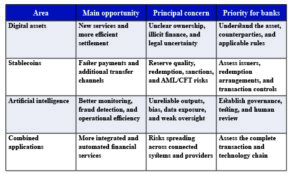
Source: Union of Arab Banks – Research Department based on U.S. regulatory guidance and banking-sector analysis.
For the Arab banks, these issues also have an international dimension. A transaction may involve a foreign stablecoin issuer, a digital-asset service provider, an overseas technology company, and a correspondent bank. Each party may apply different standards, while the bank remains responsible for understanding its own legal and operational exposure. This makes it important to establish clear procedures for identifying relevant legal requirements, assessing counterparties, documenting decisions, and escalating concerns. It is equally important to distinguish binding regulatory obligations from proposed rules, supervisory guidance, and voluntary industry practices.
Protecting correspondent banking relationships
Access to correspondent banking remains a major concern for many Arab institutions. International banks need confidence that their partners can identify customers, monitor transactions, and manage exposure to sanctions and financial crime. Digital assets and stablecoins add complexity because transactions may involve intermediaries that are not part of the traditional banking system. AI introduces another dimension: banks may increasingly depend on external technology providers to screen transactions, analyse customer information, or automate compliance processes. If these arrangements are poorly controlled, a bank may struggle to explain how a transaction was assessed or how a compliance decision was reached. That can undermine confidence among international partners, even where no violation has been established.
Therefore, the Arab banks should ensure that their technology investments strengthen, rather than fragment, their compliance frameworks. This includes maintaining reliable records, understanding the capabilities and limitations of external providers, and ensuring that responsibility for important decisions remains clear. The objective is not to eliminate every risk. It is to demonstrate that risks are understood, controls are proportionate, and potential problems can be identified and addressed promptly.
Practical Priorities for Bank Management
The first priority is governance, where boards and senior management should understand which digital-asset and AI activities the bank undertakes, why they are being introduced, and whether the institution has the expertise and resources to manage them safely. The second is risk assessment. Before launching a product or adopting a new system, banks should examine its legal implications, customer impact, cybersecurity exposure, data requirements, and dependence on third-party providers. The third is investment in people and systems. Compliance professionals need training in digital assets, stablecoin transactions, and AI-related risks. Technology teams, in turn, need a clear understanding of regulatory expectations and the bank’s risk appetite. The fourth is testing and accountability. AI systems should be assessed before deployment and monitored after implementation. Stablecoin-related services should be reviewed for redemption, counterparty, and transaction risks. Digital-asset activities should be subject to clear controls and appropriate independent review. Finally, banks should engage with regulators and international partners early. Waiting until a product is launched or a correspondent raises concerns can make the cost of adjustment much higher.
Conclusion
Digital assets, stablecoins, and AI offer Arab banks opportunities to improve payments, strengthen risk management, and develop new financial services. They also create risks that cannot be managed through technology alone. The U.S. regulatory developments are especially relevant where banks rely on dollar transactions, engage with U.S.-linked service providers, or serve customers whose activities bring them within applicable U.S. rules. Yet the broader lesson extends beyond the United States: financial innovation requires clear accountability, reliable information, and controls that keep pace with changing business models.
For the Arab banks, the goal should not be to adopt every new technology as quickly as possible, nor to avoid innovation altogether. It should be to identify where new tools offer genuine value, understand the risks they introduce, and establish appropriate safeguards before expanding their use. Banks that achieve this balance will be better positioned to maintain the confidence of customers, regulators, and international partners. In the evolving world of digital finance, innovation may create the opportunity, but trust will determine whether that opportunity can be sustained.
General Secretariat – Research Department