U.S. Regulatory Priorities and Secondary Sanctions:
Strategic Implications for Banks and Cross-Border Financial Transactions Introductions

Introductions
For banks, international banking is not an optional activity. It is essential to trade, investment, remittances, and the daily movement of money across borders. Businesses need to pay suppliers, importers need letters of credit, and individuals need to transfer funds to their families. Much of this activity depends on correspondent banking relationships, including access to the U.S. dollar. But maintaining these relationships has become more challenging. U.S. authorities are paying closer attention to how money moves through the international financial system, who ultimately benefits from a transaction, and whether financial institutions are being used to bypass sanctions or conceal illicit activity. The consequences can be serious. A bank may face regulatory action, lose access to U.S. correspondent banking services, or find that other international banks are no longer willing to work with it. Even institutions that are not directly targeted can face greater scrutiny because of their customers, business partners, or geographic exposure.
Understanding the rules: Primary and secondary sanctions
U.S. sanctions are not all the same. Understanding the differences is important because the consequences for a bank depend on the rules that apply to a particular transaction.
Primary sanctions generally restrict dealings involving designated individuals, companies, governments, or other parties where the relevant U.S. jurisdictional requirements are met. These restrictions directly affect U.S. persons and institutions, while non-U.S. banks may also be exposed through their activities, use of U.S. financial channels, or involvement in prohibited transactions.
Secondary sanctions operate differently. Under certain U.S. legal authorities, non-U.S. institutions may face sanctions for specified dealings with designated parties or activities, even where a transaction does not otherwise involve U.S. persons. Whether a particular transaction creates such exposure depends on the applicable legal authority, the parties involved, the nature of the activity, and any relevant exceptions or authorizations. A transaction involving a high-risk jurisdiction does not, by itself, establish that a sanctions violation has occurred. Depending on the applicable authority, the consequences may include restrictions on access to U.S. correspondent accounts or other measures.
Another important instrument is Section 311 of the USA PATRIOT Act. It allows the U.S. Treasury’s Financial Crimes Enforcement Network (FinCEN) to propose or impose special measures against foreign financial institutions identified as primary money laundering concerns. These measures are distinct from secondary sanctions, although their practical consequences can be similar, particularly when access to the U.S. financial system is affected.
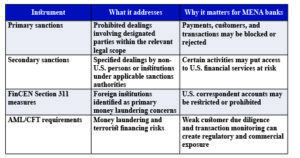
Table 1. Key U.S. regulatory instruments and their implications for banks
Source: Union of Arab Banks – Research Department based on U.S. regulatory guidance and banking-sector analysis.
These distinctions matter in practice. A transaction involving a high-risk country is not automatically prohibited, and a bank should not treat every regulatory warning as a binding prohibition. The correct response depends on the relevant legal authority, the parties involved, and the facts of the transaction.
Financial networks are receiving greater attention
Sanctions evasion rarely depends on a single transaction. It may involve several companies, intermediaries, exchange houses, shipping firms, and financial institutions operating across different jurisdictions. The purpose may be to conceal the real beneficiary, disguise the origin of funds, or make a restricted transaction appear legitimate. The U.S. authorities are increasingly concerned with these wider networks, not simply the names appearing on payment instructions. This is particularly relevant to Arab banks because the region plays an important role in international trade, energy markets, foreign exchange, and commercial links between Asia, Europe, and Africa.
A recent example illustrates the potential consequences. On 28 August 2026, the U.S. Treasury’s Financial Crimes Enforcement Network (FinCEN) proposed a special measure under Section 311 of the USA PATRIOT Act concerning Banque Misr UAE, following its assessment that the institution was a primary money laundering concern. FinCEN’s proposal cited alleged links to transactions associated with Iranian shadow-banking networks. The proposal concerns Banque Misr UAE specifically and does not extend to the bank’s operations in other countries. Although this is a proposed anti-money laundering measure rather than a secondary-sanctions designation, it illustrates how regulatory action affecting correspondent banking can have significant implications for an institution’s access to international financial services.
For other banks, the lesson is straightforward: knowing the customer is necessary, but it may not be sufficient. Banks also need to understand the purpose of significant transactions, the parties ultimately benefiting from them, and whether the activity makes commercial sense. This does not mean that banks should automatically reject transactions involving particular countries or sectors. It means that they must be able to identify suspicious patterns, investigate concerns, and explain their decisions.
Correspondent banking: The cost of losing access
Correspondent banking is one of the main channels through which sanctions-related problems can affect an institution’s wider business. Arab banks rely on international correspondents to process payments, settle dollar transactions, support trade finance, and serve corporate customers operating in foreign markets. Thus, losing an important correspondent relationship can disrupt these activities. Payments may become slower or more expensive, trade transactions may be delayed, and customers may move their business elsewhere. Other international banks may also reconsider their relationships with an affected institution because they are concerned about regulatory exposure or reputational damage.
The problem is not limited to banks that are formally sanctioned. It is important to distinguish restrictions required by law or imposed by regulatory action from decisions taken by individual banks as part of their own risk-management policies. Although both can affect access to international financial services, their legal basis and implications are not necessarily the same. This practice, known as de-risking, can affect entire markets or categories of customers rather than individual transactions. For smaller banks and institutions operating in fragile economies, the consequences can be particularly severe. Finding an alternative correspondent may take time, require substantial investment, or prove difficult altogether.
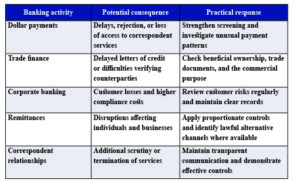
Table 2. How sanctions-related risks can affect banking activities
Trade finance and cross-border payments under greater scrutiny
Trade finance presents particular challenges because a single transaction may involve an exporter, an importer, a shipping company, an intermediary, and several banks. These parties may operate in different countries, use different currencies, and have complex ownership structures. Sanctions evasion schemes can exploit these arrangements. Companies may conceal beneficial owners, misrepresent the origin or destination of goods, or use intermediaries to hide links to restricted parties. In some cases, shipping records and commercial invoices may not accurately reflect the underlying transaction.
For Arab banks, this makes it important to look beyond the payment instruction. A transaction should be assessed in the context of the customer’s normal business, the nature of the goods, the countries involved, and the identities of the parties receiving the funds.
Technology can help. Modern screening and monitoring systems can identify potential matches against sanctions lists, flag unusual payment patterns, and help compliance teams focus on higher-risk cases. However, technology is not a complete solution. Systems may generate false alerts, while sophisticated schemes may escape automated detection. Therefore, human judgement remains essential. Compliance teams need the authority and expertise to investigate suspicious transactions, seek additional documentation, and escalate concerns when necessary. At the same time, controls should not create unnecessary obstacles for legitimate customers. Excessive delays can damage commercial relationships and undermine confidence in the banking system. The aim is to distinguish genuinely problematic activity from lawful transactions that simply require additional scrutiny.
What Arab banks should do now
Sanctions compliance should be treated as a responsibility shared by the board, senior management, business units, and compliance professionals. It cannot be left entirely to a department that reviews transactions after commercial decisions have already been made. The U.S. Treasury’s Office of Foreign Assets Control (OFAC) identifies five important elements of an effective sanctions compliance programme: management commitment, risk assessment, internal controls, testing and auditing, and training. These principles offer a useful starting point for Arab banks, although the legal obligations applicable to each institution will depend on its circumstances.
First, banks should assess their exposure by considering their customers, geographic markets, products, currencies, and correspondent relationships. This allows them to focus resources where the risks are greatest. Second, they should improve the quality of customer and transaction information. Incomplete ownership records or insufficient knowledge of a customer’s business can make it difficult to identify who ultimately benefits from a payment. Third, compliance systems should be regularly reviewed and tested. Screening software must be supported by clear procedures for investigating alerts, making decisions, documenting findings, and reporting concerns where required. Fourth, banks should maintain open and professional communication with correspondent institutions. Timely responses to information requests and clear explanations of internal controls can help reduce uncertainty and build trust. Finally, senior management should ensure that commercial objectives do not override legal obligations. A profitable transaction is not worth the risk if the institution cannot establish its legitimacy or manage the associated exposure.
 The role of regional cooperation
Arab banks do not have to face these challenges alone. Central banks, financial intelligence units, regulators, and regional banking associations can all contribute to a stronger response.
The exchange of information about emerging risks, common training programmes, and practical guidance can help banks identify suspicious activity more effectively. Such cooperation is especially valuable for smaller institutions that may lack the resources to maintain large specialist teams.
The Union of Arab Banks can play a constructive role by bringing together member banks, regulators, and international partners to discuss regulatory developments and share practical experience. The aim should be to improve compliance standards while preserving the ability of Arab banks to finance legitimate trade and economic activity. This balance is important as poor controls can expose banks to serious risks, but indiscriminate withdrawal from higher-risk markets can also have damaging consequences for businesses, households, and financial inclusion. Effective compliance should be based on the actual risks and applicable legal requirements, rather than assumptions about entire countries or customer groups.
Conclusion: Compliance as a competitive advantage
U.S. regulatory priorities and secondary sanctions are changing the environment in which Arab banks operate internationally. The implications extend beyond the compliance department to correspondent banking, trade finance, customer relationships, and the ability of businesses to move money across borders. The answer is not to withdraw automatically from every difficult market, nor to assume that existing controls are sufficient. Arab banks need a practical approach built on reliable information, effective governance, sound judgement, and regular communication with international partners. Banks that invest in these capabilities will be better prepared to protect their international relationships and support legitimate economic activity. Those that treat compliance as a formal exercise may discover that a weakness in one transaction can create problems across their wider business.
Ultimately, the challenge for Arab banking is to protect the integrity of the financial system without losing sight of its essential purpose: financing trade, supporting investment, facilitating payments, and contributing to economic development. In today’s international banking environment, strong compliance is not merely a regulatory obligation. It is an important part of maintaining trust, competitiveness, and long-term resilience.
General Secretariat – Research Department